Scaling a Botanical Drink from Bench Kettle to Beverage Plant
A botanical drink can taste finished at bench scale and still become unstable, cloudy, slow to filter, or inconsistent on the plant floor. The gap is rarely one variable. It is usually extraction kinetics, solids behavior, heat history, and separation capacity arriving at the same time.
BrixPilot supports RTD teams that need an enzyme supplier for beverage manufacturing with practical scale-up thinking, not catalog noise. The goal is simple: preserve the intended botanical profile while improving clarity, mouthfeel control, viscosity reduction, extraction yield, line efficiency, and batch-to-batch repeatability.
The bench kettle hides plant-scale risk
A small kettle gives R&D teams fast feedback. It also hides several production realities:
- Agitation is more forgiving because solids travel shorter distances.
- Heat-up and cool-down profiles are faster and easier to control.
- Botanicals hydrate differently when batch depth increases.
- Fine particles separate more easily in small sample volumes.
- Lab filtration rarely reflects the restriction points of a production line.
When the beverage moves into a plant environment, these effects become commercial. A formulation that looks bright in the lab may load filters early, drift in viscosity, or deliver inconsistent sensory intensity from one production run to the next.
Extraction kinetics: flavor is only one outcome
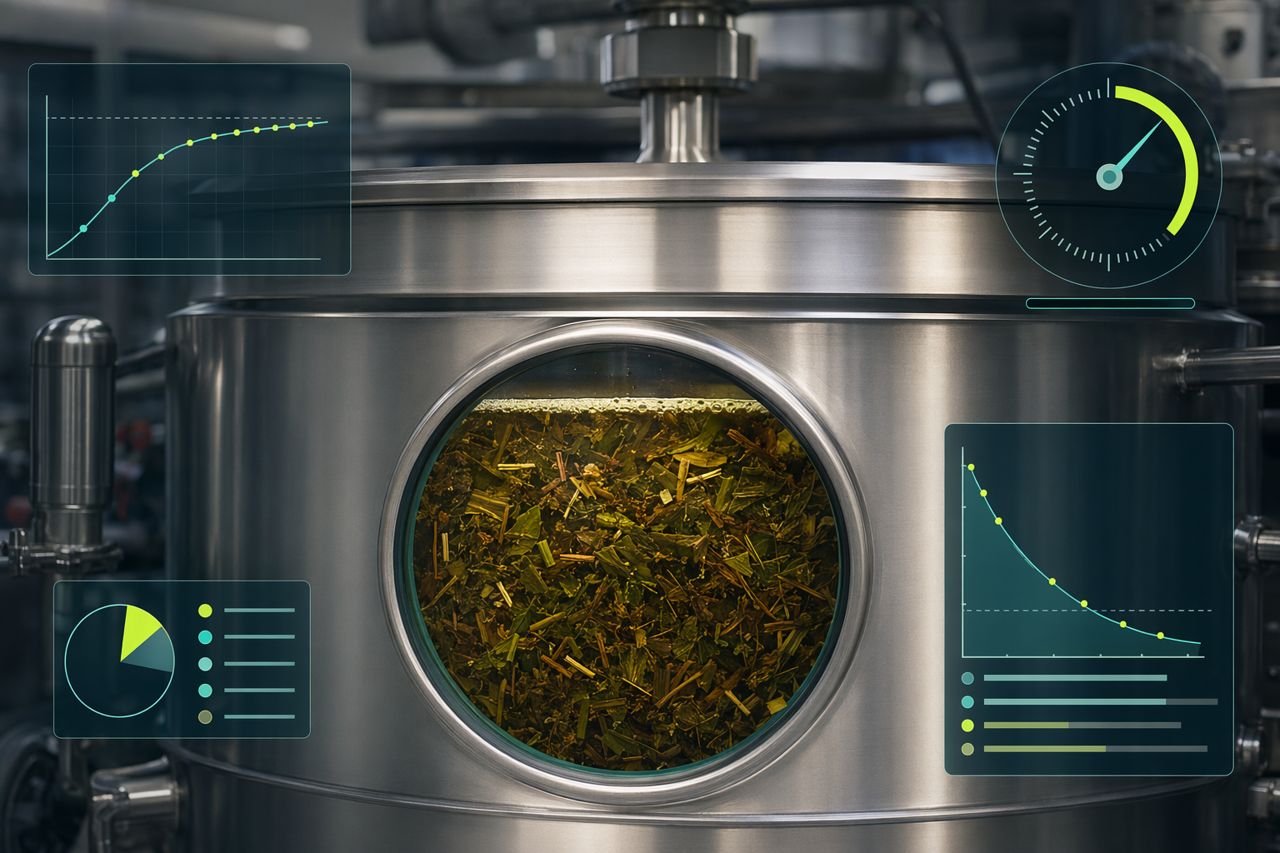
Botanical extraction is not just about pulling color, aroma, and taste. It also releases structural materials that influence haze, viscosity, sediment, and downstream separation.
Key questions before scale-up:
- Which botanical solids release desirable extractives quickly?
- Which materials continue releasing haze-forming components later in the process?
- Does extraction intensity improve yield or create separation drag?
- Does longer contact time improve flavor or overbuild body and turbidity?
- Are different botanical lots producing different viscosity behavior?
Enzymes can help make extraction more predictable by targeting plant-derived structures that trap extractable material or increase liquid resistance. In commercial terms, that can mean more usable extract, smoother transfer, cleaner separation, and fewer surprises during filtration or clarification.
Agitation: do not scale by appearance
At bench scale, a vortex can look active and complete. In a plant vessel, the same visual cue may not mean uniform hydration, enzyme contact, or solids suspension.
Poor agitation scale-up can create:
- Localized over-extraction near high-shear zones.
- Dry pockets or floating botanical rafts.
- Uneven enzyme contact with plant solids.
- Variable turbidity across the batch.
- Inconsistent draw-off behavior during transfer.
For botanical RTD production, agitation should be evaluated as a process function: wet-out, contact, suspension, temperature uniformity, and clean transfer. A technically matched enzyme program should fit the actual mixing environment, not assume perfect lab conditions.
Solids loading: the quiet driver of line efficiency
Botanical drinks often carry a commercial pressure to increase authenticity, label appeal, or extract strength. Higher solids loading can support those goals, but it can also create operational drag.
Watch for these plant-scale signals:
- Slower tank turnover.
- Longer hold times before separation.
- Rising backpressure at clarification or filtration.
- Increased sediment in intermediate vessels.
- Variable mouthfeel after blending.
- More frequent operator intervention.
The right enzyme strategy can reduce the impact of plant cell wall materials and suspended fine solids, helping the liquid move more cleanly through transfer and separation steps. The value is not abstract. It shows up as fewer interruptions, better utilization of existing equipment, and tighter finished beverage targets.
Thermal exposure: protect the botanical profile and the process window
Heat affects extraction, microbial control, color, aroma, and enzyme performance. At bench scale, thermal exposure can be brief and uniform. In production, heat history becomes a timeline: heating, holding, transfer, waiting, cooling, and blending.
Scale-up teams should document:
- Actual temperature progression, not just setpoints.
- Time spent in warm holding zones.
- Order of addition for botanicals, sweeteners, acids, and process aids.
- Sensory changes linked to heat exposure.
- Clarity and viscosity changes after cooling.
Enzyme selection should fit the intended thermal process. For a plant team, the question is not whether an enzyme works in isolation. The question is whether it works within the real operating window without forcing a disruptive process redesign.
Separation: design for the bottleneck before it appears
Many botanical scale-up problems appear as a separation issue, even when the root cause started upstream. If extraction releases too much fine material, if agitation creates an unstable particle profile, or if viscosity remains high, downstream separation carries the cost.
Commercial symptoms include:
- Filter life dropping below production expectations.
- Clarifier performance changing across botanical lots.
- Haze returning after storage.
- Sediment appearing after thermal processing.
- Finished beverage color shifting from batch to batch.
BrixPilot approaches separation as part of the full formulation and process map. Enzymes may support clearer liquid, faster solids release, improved filterability, and reduced variability, but they must be selected around the beverage matrix and the equipment reality.
Documentation: scale-up only counts if it can be repeated
A successful plant trial is not enough. The beverage team needs a repeatable operating envelope that QA, production, and procurement can understand.
Capture the process details that determine repeatability:
- Botanical supplier, lot, cut size, and pre-treatment.
- Solids addition sequence and hydration time.
- Agitation mode and practical mixing observations.
- Temperature profile and hold logic.
- Enzyme addition point and contact window.
- Separation method and observed restriction points.
- Finished beverage clarity, viscosity, mouthfeel, and stability checks.
The documentation does not need to be complicated. It needs to be usable during real production, especially when operators are managing timing, transfer, blending, and packaging pressure.
Where enzymes create value in botanical RTD scale-up
For an RTD beverage plant, enzyme value should be measured in production outcomes:
- Clarity control: reduce haze risk and support a cleaner visual profile.
- Mouthfeel control: prevent unintended thickness or graininess from plant-derived materials.
- Viscosity reduction: improve transfer, separation, and blending behavior.
- Extraction yield: unlock more usable botanical extract without overloading the line.
- Line efficiency: reduce filtration drag, waiting time, and process interruptions.
- Formulation repeatability: make plant trials more predictable across raw material variation.
This is why BrixPilot positions enzyme selection as a process decision. The best recommendation depends on the botanical system, the finished drink target, the processing sequence, and the constraint that matters most to the plant.
60-second faceless explainer
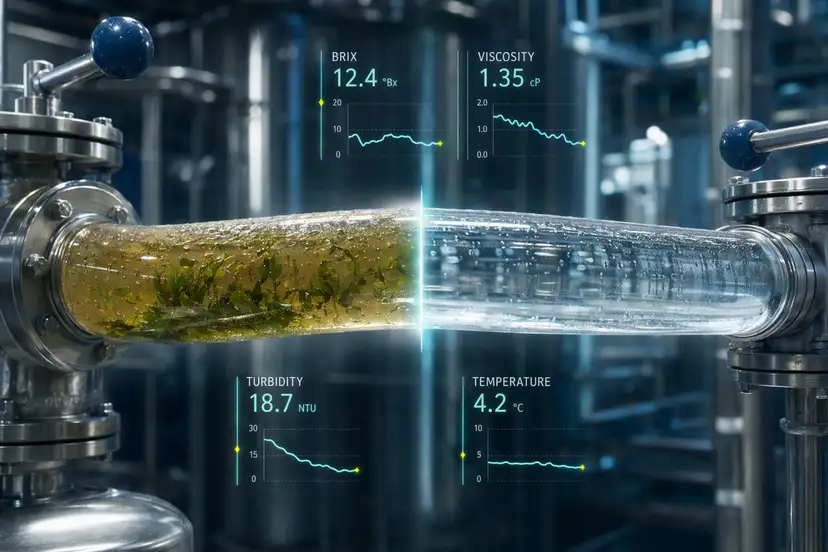
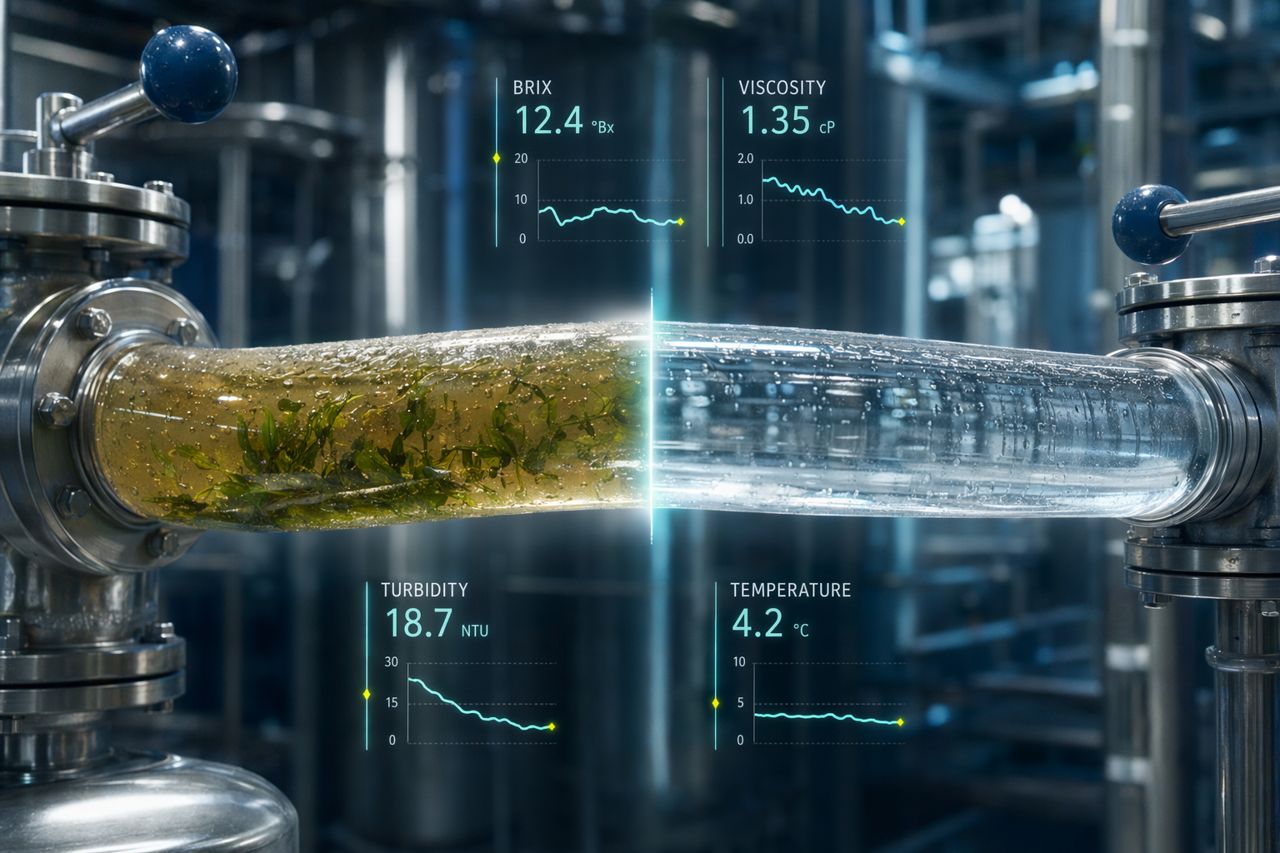
[Embedded faceless explainer video: botanical extract moving through transparent process tubing, macro clarity transitions, stainless RTD line motion, subtitles on screen, no avatar.]
A practical scale-up checklist
Before moving from bench kettle to plant trial, align R&D, production, and QA around these questions:
1. What is the target beverage behavior?
Define the commercial target before adjusting the process.
- Clear, lightly hazy, or intentionally opaque?
- Thin, rounded, or textured mouthfeel?
- Hot-fill, cold-fill, aseptic, or tunnel process?
- Still or carbonated?
- Ambient, chilled, or short shelf-life distribution?
2. What is the plant constraint?
Do not optimize the wrong variable.
- Extraction yield?
- Viscosity?
- Filterability?
- Tank turnover?
- Sediment control?
- Finished beverage consistency?
3. What changes from lab to plant?
List the non-negotiable differences.
- Vessel geometry.
- Agitation style.
- Heat-up and cool-down profile.
- Separation equipment.
- Transfer distances.
- Hold times.
- Production scheduling pressure.
4. What should the enzyme program prove?
A plant trial should have measurable business logic.
- Cleaner transfer.
- Faster separation.
- More consistent clarity.
- Better yield from botanicals.
- Reduced viscosity variation.
- Lower rework or hold risk.
How BrixPilot supports plant-ready botanical drinks
BrixPilot helps beverage teams move from promising bench concepts to repeatable RTD production. We review the beverage matrix, botanical inputs, process map, separation target, and commercial constraint before recommending an enzyme approach.
Typical support includes:
- Enzyme selection for botanical extraction and viscosity control.
- Process-fit guidance for addition point and contact window.
- Compatibility thinking around heat, pH, sweeteners, acids, and separation.
- Trial planning that focuses on plant outcomes, not lab theater.
- Documentation support for repeatable internal handoff.
Request a quote
If you are scaling a botanical drink and need a process-fit enzyme recommendation, send BrixPilot your beverage type, botanical base, target clarity, processing sequence, and current production constraint.
Request a quote using the on-site form
We will respond with a practical starting point for your RTD beverage plant.