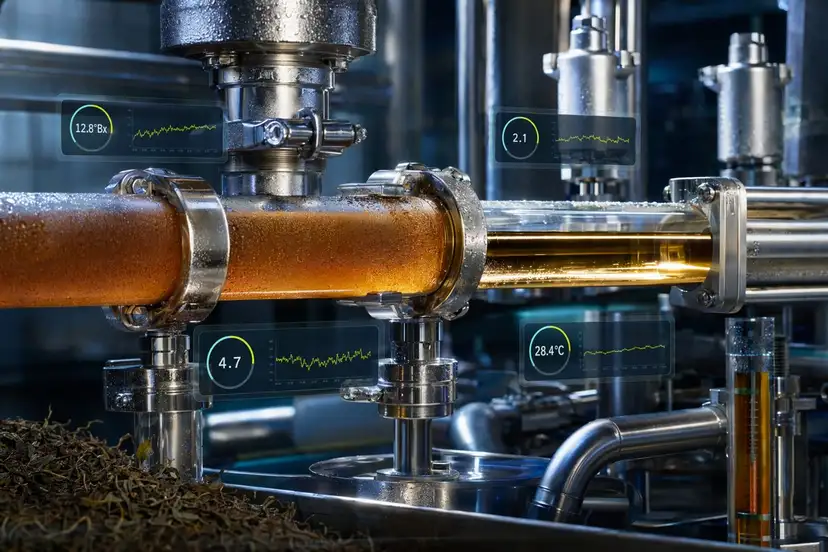
RTD Tea Haze After Hot Fill, Retort or Cold Storage
A technical guide to why RTD tea haze forms after thermal processing and cold storage, including polyphenols, pectin, minerals, suspended solids and process stress.
Request pricing A technical guide to why RTD tea haze forms after thermal processing and cold storage, including polyphenols, pectin, minerals, suspended solids and process stress.
Request pricingRTD tea can look stable at the kettle, bright after filtration, and clean through filling — then develop haze after hot fill, retort, chilled distribution, or a few weeks in warehouse conditions.
For an R&D manager, the issue is rarely cosmetic only. Haze can signal unstable solids, drifting mouthfeel, viscosity changes, filtration stress, bottle-to-bottle variation, or future sediment claims. As an enzyme supplier for beverage manufacturing, BrixPilot looks at tea haze as a process outcome: chemistry, extraction, thermal history, water profile, and line behavior all interact.
This guide explains the main mechanisms without reducing the problem to a single ingredient fix.
Tea haze forms when compounds that were once dissolved, dispersed, or too small to see begin to associate into light-scattering particles.
Common contributors include:
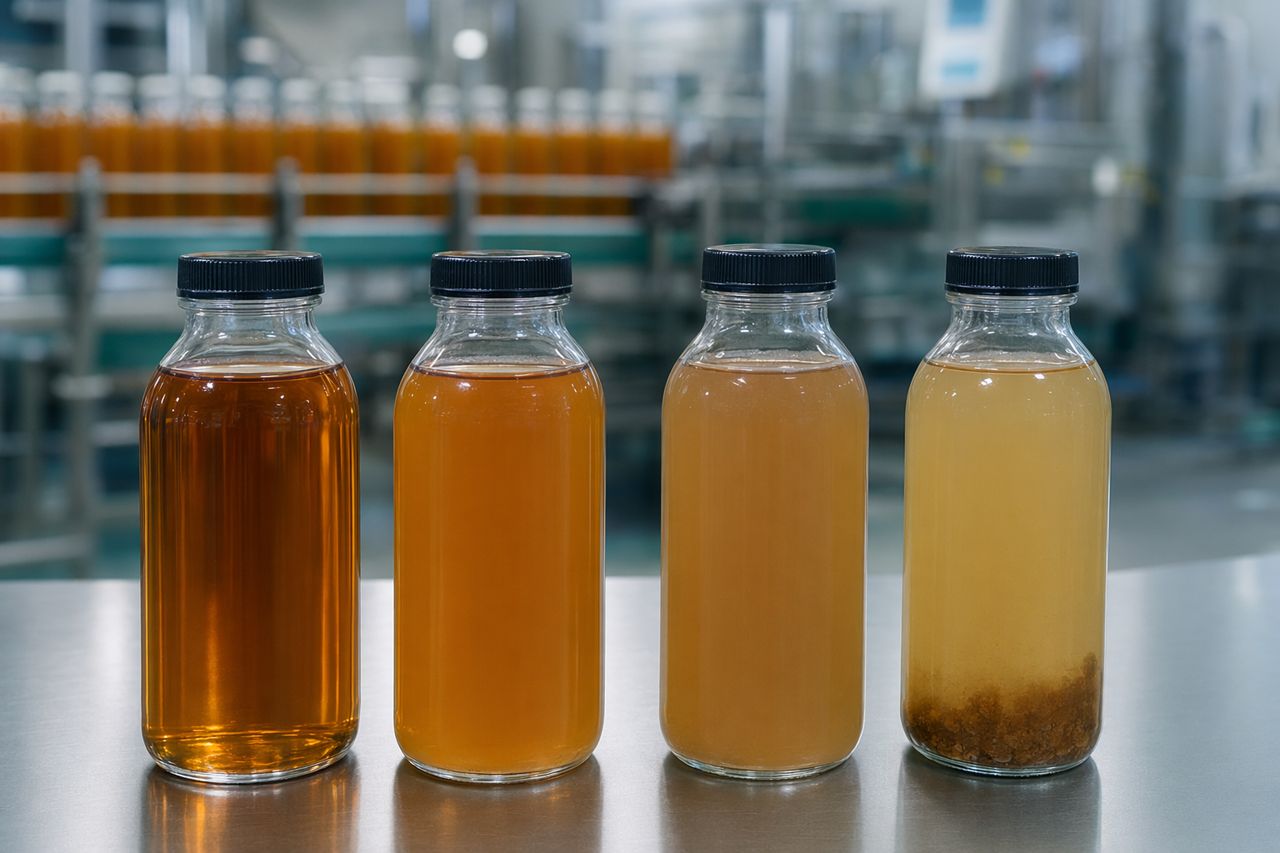
The visible result may be a light mist, a chill haze, a ring at the shoulder, a bottom deposit, or a slow loss of brightness across shelf life.
Hot fill is useful for microbial control and line practicality, but heat changes the behavior of tea solids.
During heating, polyphenols, caffeine, residual proteins, polysaccharides, and minerals can move into new associations. Some stay soluble at elevated temperature and only become visible later as the beverage cools. Others begin as very fine particles that pass through filtration but grow during storage.
A plant may see:
This is why a single finished-product clarity check immediately after filling is not always enough. The beverage needs to be evaluated against the thermal and storage conditions it will actually experience.
Retort adds stronger process stress than standard hot fill. The combination of heat load, pressure, package residence time, and cooling profile can push unstable tea systems past their clarity threshold.
Retort may intensify:
For low-acid or specialty RTD tea formats, the formulation may look stable before retort but show haze after the full process. In these cases, troubleshooting should include pre-retort and post-retort comparisons, not just raw extract evaluation.
Cold storage changes solubility. Compounds that remain invisible at warm or ambient conditions can form small particles when chilled.
In tea systems, chill haze often involves polyphenols and caffeine, but pectin, minerals, fine solids, sweeteners, and flavor components can influence whether the haze becomes persistent.
A key distinction:
For chilled RTD tea, this distinction matters commercially. A short-lived haze during cold distribution may still be unacceptable if the consumer sees the bottle at retail.
Tea polyphenols are central to color, astringency, and antioxidant perception, but they are also central to haze formation.
They can interact with:
Higher extraction intensity can increase desirable tea character, but it can also increase the load of haze-active compounds. The production question is not simply “more extraction or less extraction.” It is how to achieve the target flavor and color while controlling the fraction that destabilizes later.
Tea extracts, botanical blends, fruit-tea hybrids, and brewed bases can carry pectin and other plant polysaccharides. These materials can contribute to body and perceived fullness, but they may also affect:
A slightly viscous tea base may hold fine particles in suspension long enough to pass early QC, then release them later as the beverage experiences heat, cold, or time. In other cases, viscosity drives filtration pressure, slows clarification, or creates batch-to-batch variation.
This is where enzyme-led processing can be useful in development trials. The objective is not to strip character from the tea. It is to tune the matrix so clarity, flow, and mouthfeel are repeatable at production scale.
Water is often treated as a neutral carrier, but its mineral profile can strongly affect RTD tea stability.
Calcium and magnesium can contribute to complex formation with pectin and other negatively charged compounds. Iron and trace metals can influence oxidation and color stability. Water hardness shifts can explain why the same formula behaves differently across plants, seasons, or municipal supply changes.
Practical checks include:
Extraction yield is commercially important. Better extraction can improve beverage economics, flavor intensity, and tank utilization. But aggressive extraction may also increase fine leaf solids, colloidal material, and haze-active fractions.
The balance is specific to the product:
The target is not always maximum clarity. The target is controlled appearance and consistent mouthfeel through the intended shelf life.
Before reformulating, review the line. Haze often reflects a mismatch between the beverage matrix and the way it is processed.
Look at leaf grade, extraction temperature, residence time, agitation, water-to-tea ratio, and extract hold time. Small differences can change polyphenol load and fine solids carryover.
Review filter selection, precoat or membrane behavior, differential pressure trends, and whether viscosity is limiting throughput. If filters blind early, the issue may be upstream composition rather than filter capacity alone.
Compare clarity before heating, after heating, after cooling, and after storage. Hot fill and retort can reveal instability that was not visible in the raw base.
Long holds, headspace, transfer turbulence, and warm storage can push oxidation and complex formation. Tea bases are especially sensitive to time-temperature history.
Bottle geometry, light exposure, cooling rate, chilled storage, ambient cycling, and warehouse temperatures can all affect what the customer sees.
A useful plant trial should connect lab observations with production outcomes.
Recommended evaluation points:
The goal is to identify which variables move the commercial outcome: fewer rejects, more predictable line performance, stable appearance, and repeatable sensory delivery.
Enzymes are process tools, not magic clarifiers. Their value depends on the source of instability and the production goal.
In RTD tea systems, enzyme-led trials may be considered when the plant needs to:
Enzyme selection should be aligned with beverage pH, temperature profile, hold time, ingredient matrix, and the required sensory outcome. A clear green tea, black tea lemonade, fruit tea, milk tea, and botanical tea blend do not behave the same way.
Before running another full reformulation, ask:
RTD tea haze is easy to describe as an appearance defect, but the plant impact is broader.
Uncontrolled haze can create:
Stable clarity and controlled mouthfeel improve more than the bottle. They improve the planning confidence of the line.
The best RTD tea programs do not chase a one-time bright sample. They build a stability window that survives extraction variation, thermal processing, cold storage, and real distribution.
For BrixPilot, the practical target is simple:
If RTD tea haze is affecting clarity, mouthfeel control, filtration, extraction yield, or line efficiency, share your beverage format and process conditions with BrixPilot.
Request a quote through the on-site contact form and tell us what you are seeing after hot fill, retort, or cold storage. We will help identify a practical enzyme trial path for your production goals.

Tell us your application and volume — we reply with pricing and lead time.